Maintenance: Of Everything (2026)
Stewart Brand reframes maintenance as the work that keeps civilization alive. It left me thinking about maintenance in nature, and how it hides inside survival itself: maintenance is built into everything that lives.
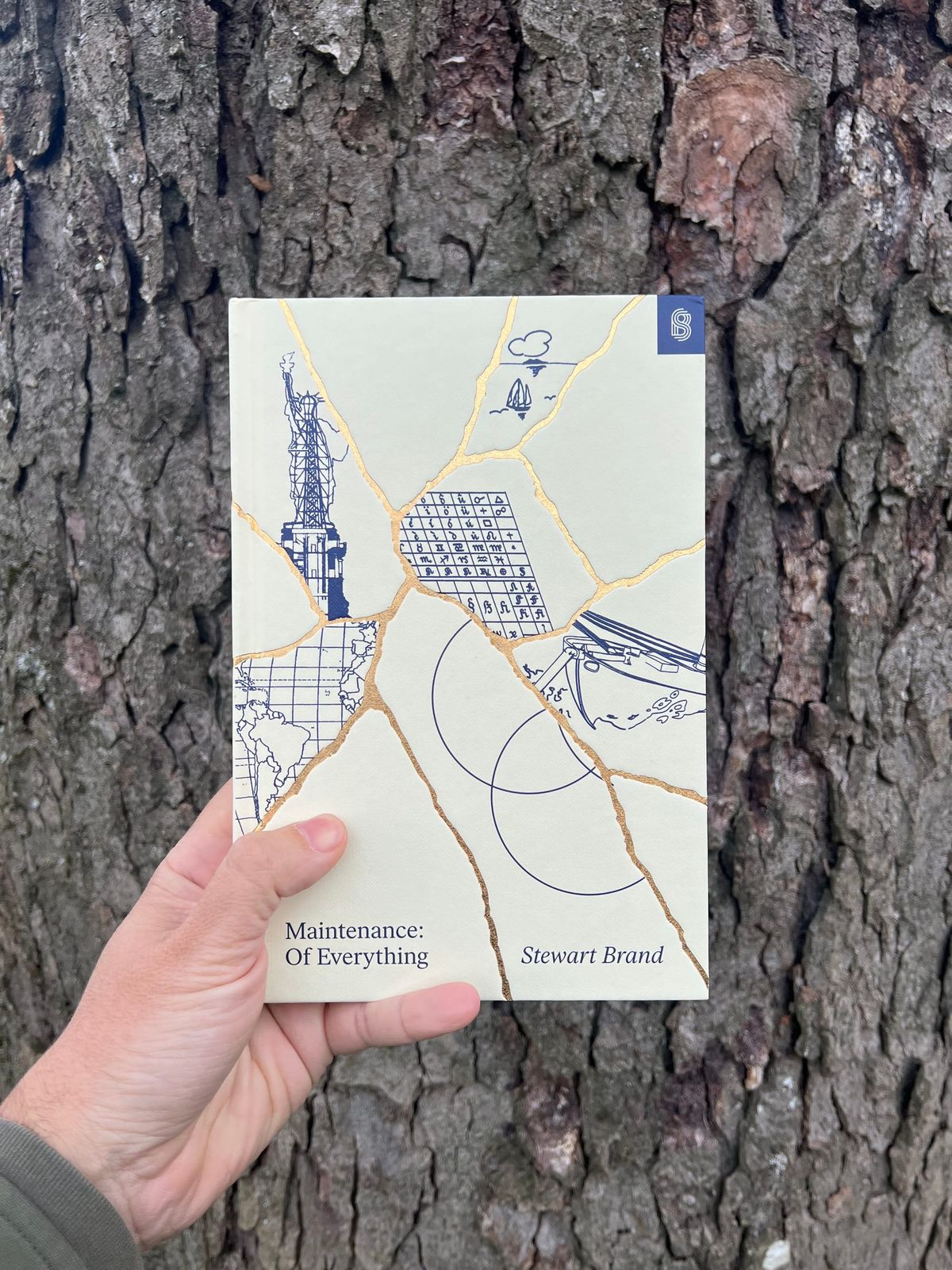
“Maintenance is what keeps everything going. It’s what keeps life going.”
— Stewart Brand, Maintenance: Of Everything, Part One (Introduction, 2026)
Stewart Brand opens his book in 1968, with nine sailors racing alone and non-stop around the world. Whatever broke at sea, they had to fix themselves, or it stayed broken.
Three of them became legends, and each sailed with a different idea of maintenance:
“Hope for the best.” It killed him.
“Whatever comes, deal with it.” And he did.
“Prepare for the worst.” It freed him.
Robin Knox-Johnston won the race. Bernard Moitessier won the maintenance race.
By the end of the first chapter the lesson is already clear: the best maintenance is designed in before anything breaks. The rest of the book proves it again and again, with stories just as fascinating, from rifles and factories to bridges and rust.
I have admired Stewart Brand’s Whole Earth Catalog for most of my adult life, and I’ve collected both the first edition (1968) and the last (1971). The two copies that bookend Brand’s great project sit on the same shelf, barely three years apart in print and a whole era in between. The fact they are still legible, still holding their glue, is itself maintenance — the work of a cascade of hands across six decades, mine only the latest.
I discovered the book while browsing the Stripe Press site. The moment I read “Maintenance” and saw Brand’s name on it, I didn’t hesitate. I love their editions and I’d already enjoyed Working in Public (Nadia Eghbal, 2020), which quietly argues the same thing from inside software:
The romance is in the building,
but the work is in maintaining it.
And Brand practiced what Eghbal preached. He drafted this book in public, section by section, on Books in Progress — inviting strangers to debug his prose the way he once invited readers to review tools. Some 73,000 of them showed up, many staying to argue in the margins. “Given enough eyeballs, all bugs are shallow,” he writes, quoting Eric Raymond.
The book about maintenance was maintained by the same collective intelligence the Catalog ran on.
The cover is kintsugi, gold poured into the cracks of a broken thing: the repair made more beautiful than the original. You become mesmerized by the cover for a while before you open it.
What I Came Looking For
I came to this book hoping it would confirm a belief I’ve carried for years. That everything humans build degrades — bridges rust, code rots, monuments crumble — while nature builds things that get stronger over time. I live close to the Lañilawal, the oldest living individual on Earth, a tree (Fitzroya cupressoides) that has been standing since before the Catalog’s first edition by a factor of thousands. I wanted Brand to tell me that the sequoias and the Lañilawal had escaped the curse that follows everything we make. More than confirmation, I wanted the correlation: how biology itself faces maintenance, what the living does that the built cannot.
He named it, then walked on. Brand opens under a line from Pete Seeger (maintenance as the essential art of civilization) and on his first page observes that every living thing spends its life maintaining itself and the systems it depends on. “Plants tend the life of the soil they grow in,” beavers keep their dams. Then, having gestured at the living world, he turns to the built one and stays there for the rest of Part One: vehicles, weapons, factories, the long war against rust. The forest I came for is a sentence, not a chapter.
So I followed the sentence myself. For the living, maintenance is not a line item to schedule and skip — it is survival itself, and survival is never deferred.
The Lañilawal hasn’t escaped maintenance — it is the most maintained thing in the forest. Every second of its five-thousand-year life it is sealing wounds, replacing cells, regrowing canopy, fighting rot and beetles and fungus, paying for all of it with a constant trickle of metabolic energy. The second law of thermodynamics never gave the tree a discount. The tree simply never stopped paying the bill. It gets stronger because it never defers the work.
Nature doesn’t escape maintenance.
It happens internally, and never once gets deferred.
That single inversion is worth the whole book to me. What we do on purpose, with manuals and budgets and grease — biology does automatically, inside, for free. The difference isn’t whether a thing requires maintenance. Everything does.
The difference is where the maintenance lives: external and deliberate for the things we build, internal and automatic for the things that grow.
The Education of a Fixer
What I didn’t expect was how much I’d learn about the texture of maintenance — its styles, its nuance, its quiet politics.
Brand opens with those three sailors, and from there the book wanders — gloriously — through interchangeable parts and the birth of precision manufacturing, through manuals nobody reads, through the military’s unglamorous word for keeping things alive (“sustainment”), through the strange durability contest between the AK-47 and the M-16, through the slow patient war that every made object fights against corrosion.
The structure underneath all of it is simple and clarifying.
- Preventive: the maintenance you do before.
- Deferred: the maintenance you postpone.
- Emergency: the maintenance you’re forced into when the postponing runs out.
The whole drama of the built world plays out in the traffic between those three.
What I Confirmed, and What I Did Not
Here is the takeaway I arrived with, and which the book sharpened rather than overturned: when we design for maintenance from the very beginning, it rarely becomes a problem.
It’s only when we build on the assumption that nothing will ever need maintenance that we fail — and we fail spectacularly, because we’ve designed the failure in from the start.
That part holds. But Brand adds the half I was missing. Designing for maintenance is necessary; it is not sufficient. The bridges that fall were almost always maintainable. Someone could have kept them. The money was never budgeted, or the manual was lost, or the people who knew-how quietly retired and weren’t replaced.
The real killer isn’t the thing you forgot to design for. It’s the thing you designed perfectly and then chose, year after small year, not to tend.
Deferred maintenance is the most human catastrophe there is, because every individual decision to defer is reasonable, and the collapse only shows up in the sum.
This is the part that sits closest to everything I think about — soil, ecosystems, the slow tending of living systems that don’t announce their needs until it’s too late to negotiate. A forest doesn’t send an invoice. Neither does a friendship, a marriage, a democracy, a coral reef, or a sixty-year-old catalog about looking at the Earth whole.
And of everything we postpone, nature is the priority we defer the longest — because somewhere we quietly filed it under “emergency”. We’ll fix it later. We’ll fix it just before we can’t breathe the air or drink the water.
But emergency maintenance has a limit the bridge engineers know and we keep forgetting: some failures don’t wait for the repair crew. You can rebuild a bridge. You cannot reissue a wetland. The Lañilawal that took five thousand years to grow has no emergency tier — no budget line, no manual, no crew that brings it back within a human lifetime. Kintsugi only works when the pieces on the table can still be put back together.
The Catalog answered this sixty years ago, quietly: the things worth keeping are never kept alone. “Access to tools” was always access to each other.
So the question Brand leaves me with isn’t really about bridges or boats. It’s the one I keep turning over while looking at my copies of the Catalog, paper cracks and all:
What if the one system we keep deferring is the one with no emergency repair — and we only learn that the moment it’s already gone?