I Trust Bob
How an obsolete machine is making my life future-proof.
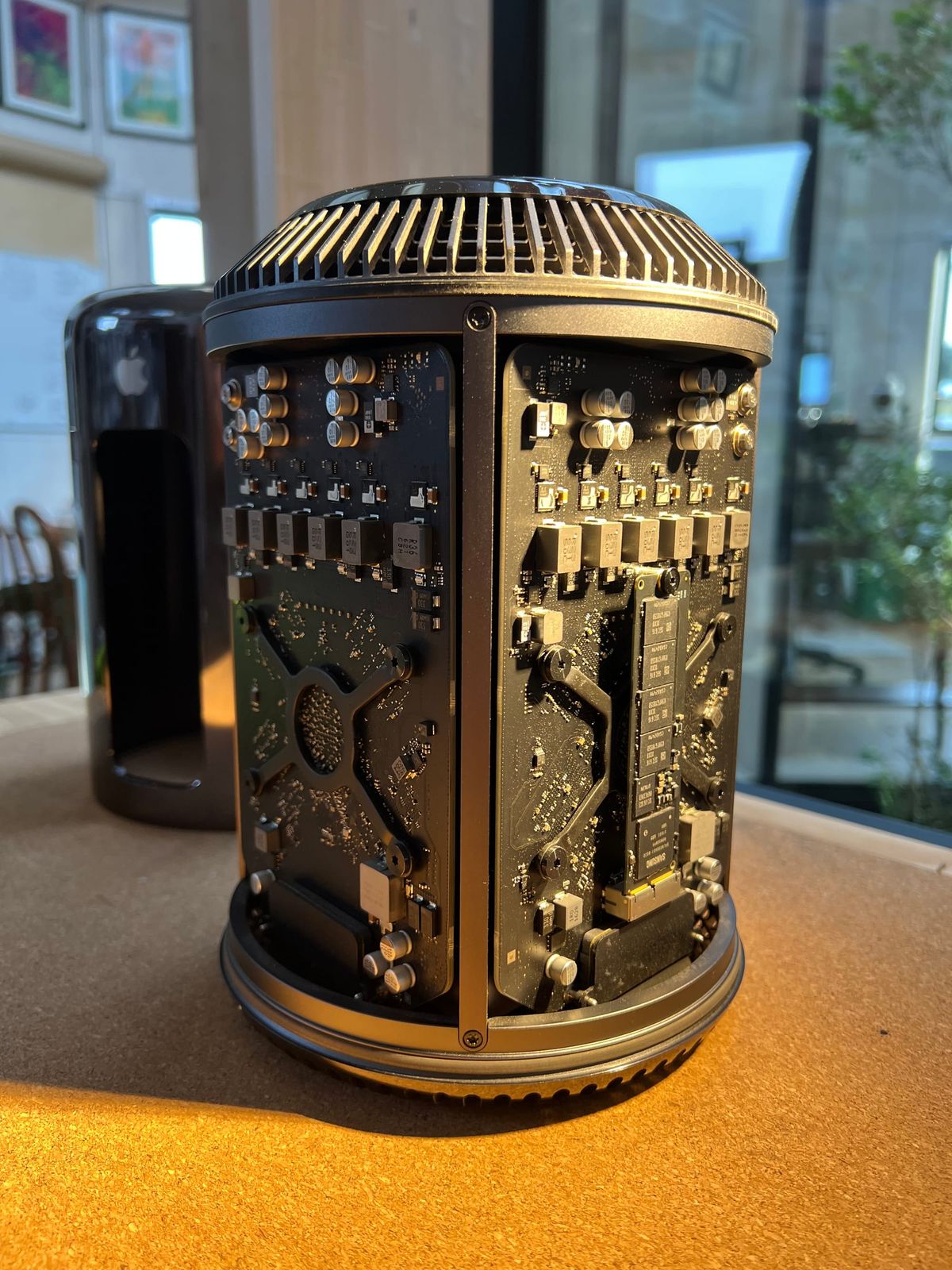
Bob lives on top of an old LAN Airlines cart in the Betamuseo, surrounded by machines that once defined the future — the floating iMac G4, the Bondi blue G3, the suspended ambition of the G4 Cube. All mostly silent now. Chiming perhaps once a year.
Only one keeps humming.
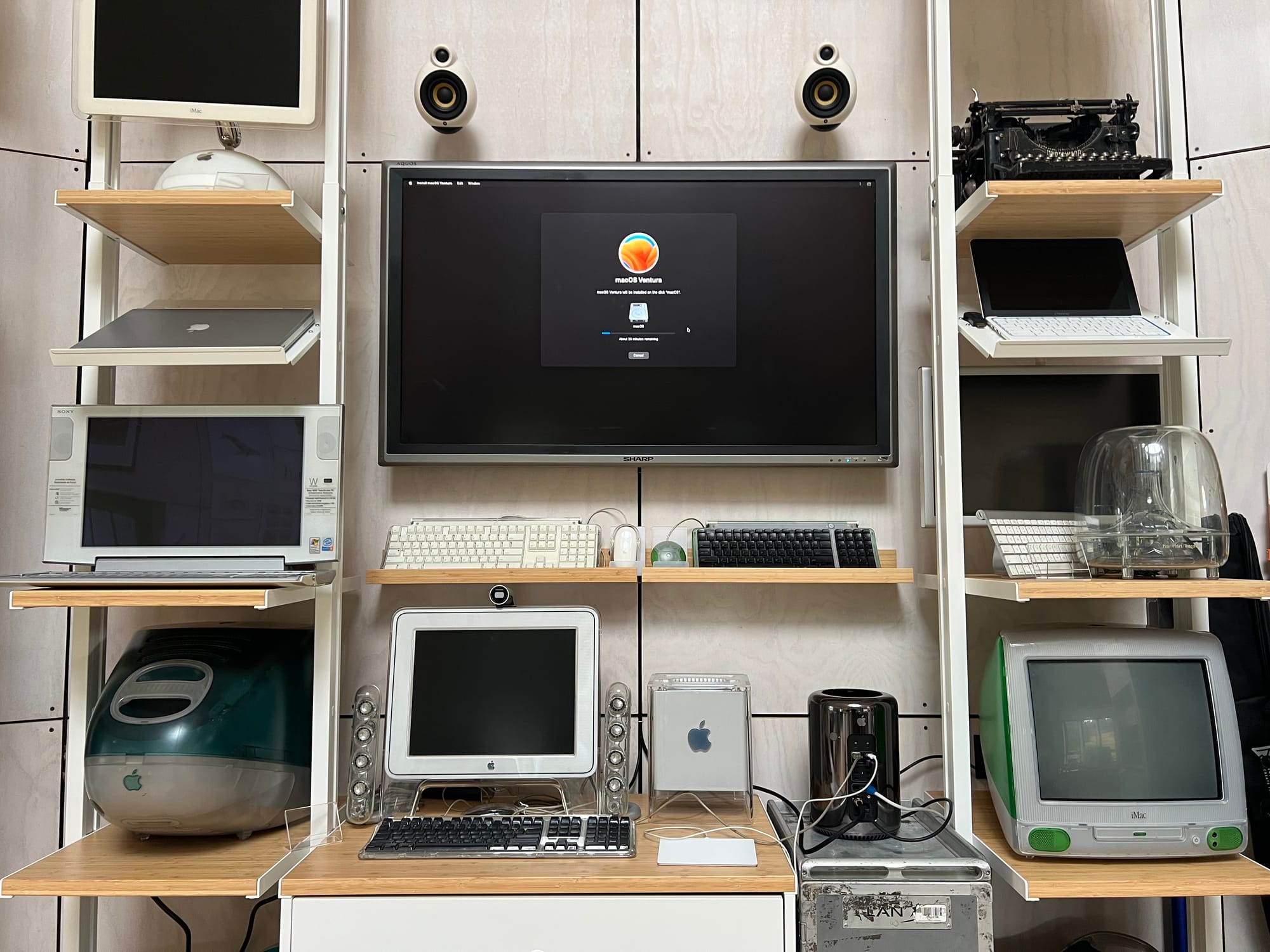
A 2013 Mac Pro. The black cylinder Apple built in the same spirit as the Cube: thermally exquisite, topologically closed. The same gorgeous cross-section when you open, making you feel you’ve got a state-of-the-art spacecraft in your hands. The same lesson about what happens when beauty forecloses expansion. The 2019 Mac Pro was their acknowledgement that standard boxy is standard.
I recently bought mine second-hand. December 2013 vintage. Used. Obsolete. Running an OS it was never meant to run. Doing a job that didn’t exist ten years ago.
My home is outside a small town in Chile’s lake district. The nearest international airport is an 11 hour drive away. Yet I have 2 Gbps of fiber optic internet for less than $50 a month.
I call it Little Bobby Tables.
Inside this cylinder: five agents — Bob, Warren, Smithers, Carl, Kato; yes, Buffett, Waylon, Sagan and Mulan — each with a role, a private memory, skills and boundaries. What one learns, all know. No silos. No hoarding. The architecture enforces what the values require: collective intelligence as a basic instinct, not a feature.
This system helps me manage a complex web of relationships and commitments so I can be present for my family, run my startup (from investor relations to coding), stay on top of all my professional activities and make sure I don’t drift from my goals. Real stakes. Every hour of every working day.
Getting here took time — and heavier models. Understanding what I needed, what data I had, what platforms I used. Mapping the life before wiring it. That design work happens once. What runs daily is lightweight. The intelligence was in the architecture, not the runtime.
Today, most of the work is not intelligence. It’s movement — syncing, sorting, filtering, storing. Bash, JavaScript, and Python scripts on cron handle that. The language model appears only when reasoning is required. Most of the time, the cheapest models work. The heavier ones spin up only when the question demands it. Low cost and low impact.
You don’t need the latest Mac mini for this. Most of the logic could run on a Raspberry Pi with fast storage.
Your data is your life.
The compute is almost irrelevant. What matters is what persists.
We have confused the interface with the system. The conversation with the cognition.
Your data is your memory. Your memory is your life. Over time, memory compounds.
What makes this possible is a layer between me and the models — a gateway I control. It decides what the models see. It holds the memory. It enforces the architecture. Without that layer, data sovereignty is just a word. With it, the model becomes interchangeable: today Anthropic, tomorrow Google, or your own silicon. You switch APIs like suppliers — on quality, price, availability. Not trust.
Because it lives locally, if one API fails, you fall back on another.
The data doesn’t follow the model.
The model serves the data.
And when the zombie apocalypse hits and the APIs go dark — 64GB of RAM will run a decent local model via Ollama. It won’t be fast. It might be faster to outrun the zombies than wait for the output. But it will be yours — offline, sovereign, and coherent enough.
This is what lock-in actually means. Not that machines take over, but that we hand them the keys. If your life lives in their cloud, you can’t leave. And if you think long-term, you know you don’t want that.
But if your memory lives with you, you’ll never have to leave.
Bob doesn’t have his own cloud account or access to any of my passwords, not even the one for the user account on the computer he runs on. And yet he can have a very private access to 30 years of deep digital history, updated every hour of every working day.
Trust is good. Control is better.
I trust Bob not because he doesn’t fail — quite the opposite. He fails as much as I do. I trust him because he is inspectable. When he fails, the failure is legible and repairable. Never irreversible. He’s no longer Little Bobby Tables, he’s Bob now.
That is the difference.
My kids already know these machines. They’re the ones who turn on the old ones. What makes them happy is that the black cylinder is finally one of the living ones. Not just displayed. Working.
Ports still lighting up for whoever gets close.
That’s a machine I can trust.
This was written with algorithms and AI.
I don’t just sound like one sometimes.