A Choice of Catastrophes (1979)
At cosmic scale, catastrophe is inevitable. At human scale, it is optional. A 1979 map of constraints that reads, fifty years later, like a diagnosis.
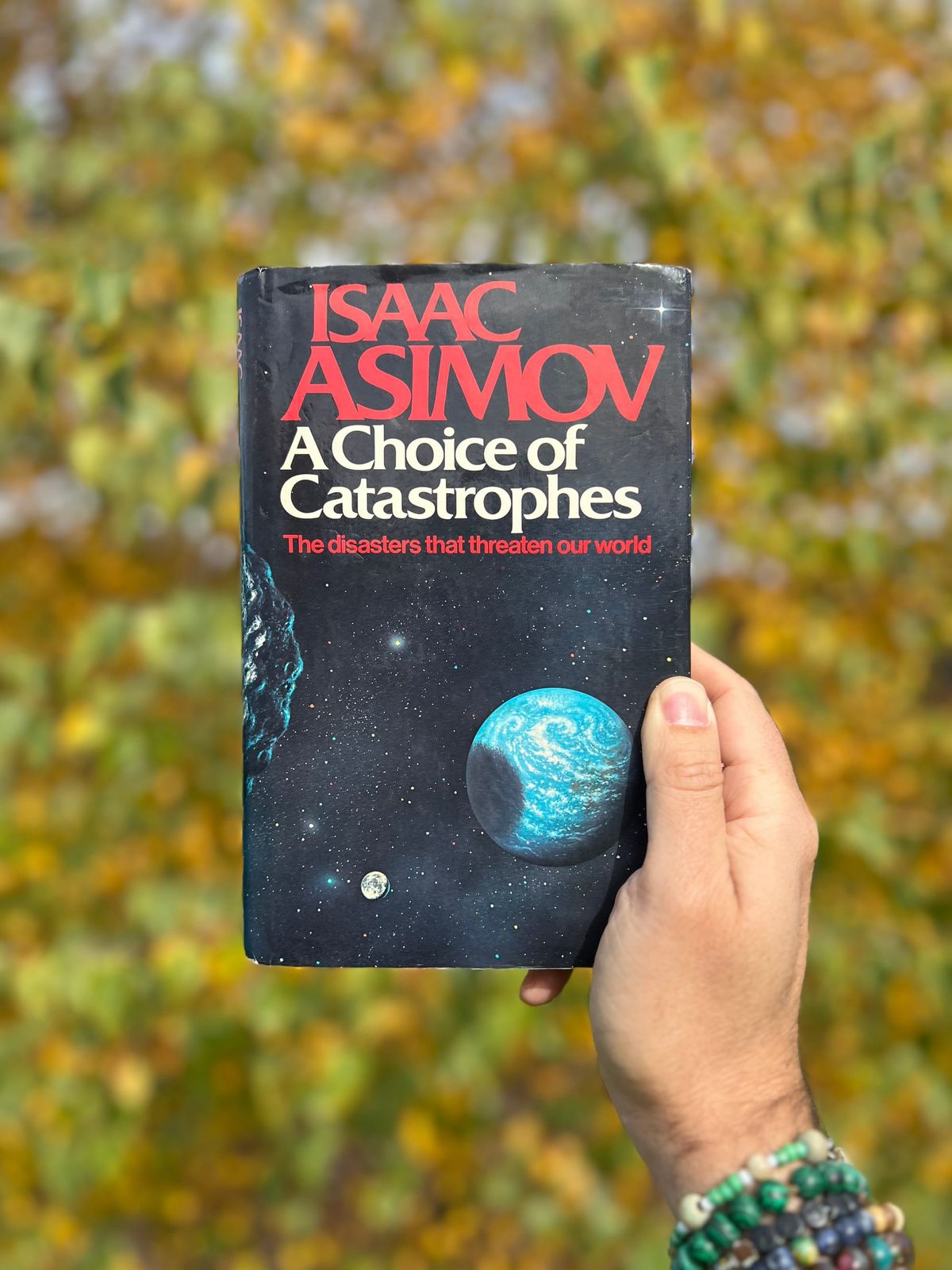
“There is nothing that threatens us with imminent destruction in such a fashion that we are helpless to do something about it… if we behave rationally and humanely, rather than emotionally on such nineteenth-century matters as national security and local pride… we can deliberately choose to have no catastrophes at all.”
— Isaac Asimov, Afterword (A Choice of Catastrophes, 1979)
I read this flat on my back after a routine operation. A (rare) forced pause. Late last winter in Patagonia: quiet house, short days, long nights. The right conditions for a book that stretches across the lifetime of the universe.
What if, almost half a century ago, someone wrote down every way the world could end — and most of what he said would happen, did?
The title is dramatic. The book is not. The world hasn’t ended, yet. Asimov writes this more than two hundred books into his career, in the year I was born, with the calm of someone who has studied the same patterns repeat across scales.
Five Classes of Ending
Asimov sorts the apocalypse into five classes, from farthest to nearest. Class one ends the universe. Class two ends the solar system. Class three ends the Earth. Class four ends humanity. Class five ends civilization but leaves a few survivors behind, to start over the hard way.
Each chapter walks calmly through one way it ends. Heat death. The collapse of stars. The death of the Sun. The bombardment of the Earth. The drift of the crust. The change of weather. The competition of life. The conflict of intelligence. The depletion of resources. The dangers of victory. No drama, no prophecy — a patient mind looking at what is there, and naming it.
The structure does the work. As you move through the classes, the timescales shrink. The cosmic catastrophes — the ones we cannot prevent — sit billions of years away. The Sun will do what the Sun will do. The closer you get to the present, the more the catastrophes start to look like us. By Class five there is no asteroid. Only resources we are spending, populations we are stressing, weapons we have built, intelligence we have not yet learned to use well.
Once you reach that final catastrophe, it feels as if the whole book was just a preamble to the only catastrophe that matters.
At cosmic scale, catastrophe is inevitable. At human scale, it is optional.
The Things He Saw
I keep finding myself reading old futurists. Not for prediction scorecards — for the strange experience of standing in their imagined future and looking back at what they could and couldn’t see. What changed beyond recognition. What didn’t change at all.
Reading it now, a quiet inversion comes into focus. We assume intelligence protects us. But much of what Asimov describes are catastrophes enabled — or accelerated — by intelligence itself. We discover energy and we scale it. We discover chemistry and we industrialize it. We discover biology and we modify it. Each step is rational where it stands. The cost lands somewhere else, later.
This is where the book becomes less about catastrophe and more about time. Not the time of headlines or quarterly reports. The time of accumulation. The time of thresholds. The time where cause and effect drift apart just enough to become unrecognizable.
A forest does not disappear the day the last tree falls. It disappears years earlier, when regeneration quietly stops working.
What stays with you is what he saw early. A Global Computerized Library — open to all people of any age, any film, paper, magazine or book on demand — a decade before the World Wide Web. Surrogate motherhood — busy career women contributing egg cells, fertilized and implanted in surrogate mothers — written in 1979, the year after the first IVF baby. A full chapter on the depletion of resources and the limits of the atmosphere as a sink. And then, on the very last page, what he calls the union of brains, human and human-made — the doorway through which the human being could emerge from its isolated childhood into its in-combination adulthood.
Read in 2025, that last line is hard to put down. Half a century before the current debate about AI as replacement or partner, the answer was already on the page. Not humans versus machines. Not machines instead of humans. “In-combination.”
“The question of replacement need never arise. What we might see, instead, would be symbiosis or complementation; brain and computer working together, each supplying what the other lacks, forming an intelligence-pair that would be far greater than either alone.”
— Isaac Asimov, The Dangers of Victory (A Choice of Catastrophes, 1979)
Nineteenth-Century Concerns
Asimov saves his point for the Afterword, and he is unusually direct. “Nineteenth-century matters”, he calls them: national security, local pride. The leftover concerns of a previous century. The kind of thing a species was supposed to grow out of before it grew up.
He wrote that almost fifty years ago.
Today those same nineteenth-century concerns dominate the headlines. Borders. Flags. Tribes. Outdated operating systems still running critical infrastructure. The cosmic catastrophes are still patiently waiting their turn, billions of years away. The avoidable ones are still right here, exactly where he left them.
Asimov does not prescribe — that is not the book he wrote. What he offers is more foundational: a map of constraints.
A reminder that we are operating inside systems we did not design, cannot fully observe, and are only beginning to understand.
And that most of our decisions — economic, technological, political — are still made as if those systems were stable, infinite, or irrelevant. They are none of those things.
Lying there, in that quiet week, the book did not feel alarming. It felt clarifying. Most endings are not sudden. They are built. Slowly. Logically. Often intelligently. And that is the part that remains open. Because if catastrophes at our scale are constructed, they can also be unbuilt.
Everything ends. But not everything ends the same way. At our scale, that difference is still ours — so what are we choosing?